


11
August, 2026
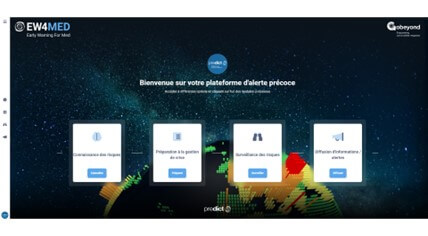
In the face of evolving natural hazards and the increasing occurrence of extreme hydrometeorological events, having access to reliable, accessible and operational information is key to ensure the protection of people and territories.
Developed as part of the European GOBEYOND project, the Early Warning for Med (EW4MED) platform aims to improve early warning systems in the Mediterranean region. The platform aims to facilitate the exchange of information, preparedness and the coordination of protective measures amongst the various stakeholders.
Relying on PREDICT Services’ operational expertise, EW4MED brings an overall approach to risk management. Its aim is to enable decision-makers to transform technical data and potential hazards into an operational response that is tailored to the actual nature of the threat.
The whole process can be summed up by the answers to these three key questions: what is the risk level in the areas concerned? When should actions be taken? What measures should be implemented?
The platform thus combines, within a unified environment, the data needed to prepare operational responses, to understand both anticipated and ongoing risks, and to supervise the measures taken.
EW4MED contributes to the Early Warnings for All (EW4ALL) initiative launched by the United Nations, which is structured around four complementary pillars: risk awareness, preparedness, monitoring and information dissemination.
The first step in crisis management is to have a thorough understanding of the geographical area and its associated risks: what types of events are most likely to occur? Which locations are the most exposed ? Which populations, infrastructures or activities are likely to be impacted?
EW4MED enables this data to be consolidated through a map-based overview of the territory, incorporating hazards, key issues and, consequently, exposures and vulnerabilities. This shared overview helps stakeholders to improve their identification of vulnerable areas and to prepare suitable actions before an event occurs.
The efficiency of crisis management relies heavily on prior preparation. The EW4MED platform provides support to stakeholders in establishing and organising their emergency response and procedures.
In addition, it allows operational tools to be structured, risk management maps to be drawn up, and the actions and processes to be undertaken and centralised.
Each stakeholder thus has access to information tailored to their specific role, facilitating the transition from risk awareness to effective action.
The EW4MED platform enables different data sources to be cross-referenced in order to monitor how phenomena evolve and to assess the level of risk in a given area more accurately.
Weather and hydrological forecast data are analysed in conjunction with observational data collected in real time and cross-referenced with the characteristics of the area: exposed areas, key issues and vulnerabilities. Beyond simply understanding the risk, this approach enables us to gain a comprehensive understanding of the phenomenon by assessing its potential impacts.
EW4MED thus provides managers with a contextualised view of the situation, enabling them to adapt their decision-making and protective measures in accordance with the phenomenon’s dynamics.
When a major event occurs, coordination between the various levels of crisis management is essential.
The platform is therefore designed to operate and facilitate collaboration across different scales of decision-making and management. It can meet the needs of stakeholders involved at national, regional or local level, whilst enabling coordination between these different scales as well as with other operational services or partner organisations.
EW4MED helps share information through a common platform that allows users to monitor risks, decisions taken and actions undertaken on the field. This multi-level approach ensures that each user has access to information tailored to their level of responsibility, whilst maintaining an overall view of the situation.
This collaboration improves coordination during the crisis and facilitates the feedback process after the event.
One of EW4MED’s key strengths lies in its ability to take account of various types of hazards. It supports local authorities in dealing with hydrometeorological and geological hazards, such as heavy rainfall, flooding, landslides, thunderstorms, storms, coastal flooding, heatwaves and cold spells.
Furthermore, its interoperability allows it to integrate various data sources and to be adapted to and integrated in with existing other systems, thereby improve circulation of data between stakeholders and ensuring that the system is fully tailored to everyone’s needs.
EW4MED is supporting a major shift in the way risk management is conceived: moving away from an approach focused solely on alerts towards a comprehensive decision-support approach, based on potential impacts and, above all, the early action to be taken.
By bringing together risk awareness, operational preparedness, anticipated and real-time analysis of the severity, consequences and impacts of phenomena, and, finally, a system for disseminating and sharing information, the EW4MED platform helps to strengthen territorial capacities for anticipating events, taking action, coordinating efforts and saving lives, property and economic activities.
Developed to address the specific requirements of those involved in risk management, the EW4MED platform has been deployed in the management of high-risk events affecting the Mediterranean basin.
During the 2026 winter, it was deployed to forecast, analyse and manage high-risk hydrometeorological events, such as the floods that affected southern Europe, Morocco and Tunisia. It was also deployed in 2026 to address summer risks affecting southern Europe, such as severe thunderstorms, intense heatwaves and wildfires.
These examples highlight the platform’s ability to meet the needs of risk managers faced with various types of events and stakeholders operating at different geographical scales, and to provide stakeholders with a shared view of the situation to ease coordination and decision-making.
As part of the GOBEYOND project, the EW4MED platform is therefore helping to develop an early warning and response system, initially designed for the Mediterranean region – a hotspot for climate change and its associated risks – by harnessing technology to achieve a key objective: to improve protection for local communities and reduce the impacts of extreme events.
The GOBEYOND project has received funding from the European Union’s Horizon Europe programme for research and innovation under grant agreement No. 101121135.
 Retour